

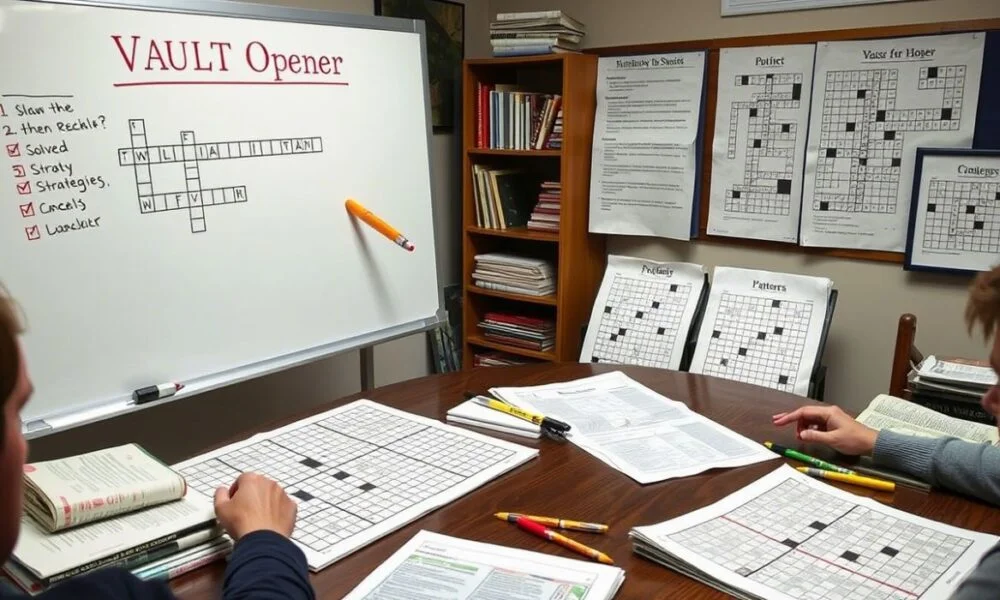
In the meticulously crafted world of The New York Times crossword,The Vault Opener where every shaded square and pun is a deliberate choice, few things spark the collective imagination of the solver community like a tantalizing, recurring meta-puzzle. Enter the “Vault Opener”—not just a clever clue, but a burgeoning legend within the puzzle pages. This elusive key has evolved from a one-off answer into a captivating treasure hunt, a ritual of intellect and shared discovery that transcends the daily grid.
The story begins, as many modern crossword myths do, with the puzzle’s esteemed editor, Will Shortz, and his stable of brilliant constructors. The “Vault” first materialized not with a bang, but with a whisper—a clue that seemed slightly odder, more specific, and more self-referential than usual. Perhaps it was a Thursday puzzle with a twist, where solvers found that correctly answering a particular clue yielded an answer that felt like a tool, a code, or a key. The term “Vault Opener” itself is metaphorical; it’s the answer that “unlocks” a secondary layer of the puzzle, often leading to a final, unifying meta-solution or a hidden message.
The genius of the Vault Opener concept lies in its layered deception. On the surface, the puzzle functions perfectly as a standard, if challenging, crossword. You fill in the squares, you conquer the wordplay, you pencil in the last letter. But for the astute solver—the one who reads the title, notes the unusual entries, or senses a thematic pattern—there’s a lingering sense of something more. The Vault Opener is the linchpin. It might be the answer to the clue that the puzzle’s title hints at but never directly asks. It could be the common thread linking a series of seemingly unrelated theme answers. Often, it is the final piece of information needed to decipher a code spelled out by circled or shaded letters, revealing a quote, a person, or a punchline.
This transforms the solving experience from a solitary test of vocabulary into a collaborative archaeological dig. On forums like the Wordplay blog, Reddit’s r/crossword, and crossword Twitter, the post-puzzle dissection is a key part of the ritual. The moment a solver suspects a meta-layer, the hunt for the Vault Opener begins. Posts buzz with speculation: “Did anyone else notice the unusual pattern in the central acrosses?” or “I think the title ‘Bank Shot’ is pointing us to the VAULT OPENER, but what is it?” The community collectively tests hypotheses, shares “Aha!” moments, and celebrates when someone first identifies the critical key. In this digital age, the Vault Opener isn’t just found; it’s socially constructed, its significance affirmed by the collective “click” of understanding spreading through the community.
The role of the constructor in this drama is that of a benevolent trickster. Crafting a puzzle with a successful Vault Opener requires a diabolical level of craftsmanship. The constructor must build two perfectly interlocking puzzles: one that stands on its own, and a second, hidden one that is elegant and satisfying once revealed. The Vault Opener must be fair—deducible from the clues and grid without external knowledge—yet cleverly obscured. It’s a high-wire act. If it’s too obvious, the meta-puzzle feels cheap; if it’s too obtuse, it feels unfair and frustrating. The best Vault Openers create a moment of sublime revelation, a feeling that the solver has been let in on a wonderful secret.
Psychologically, the appeal is powerful. In a world of infinite scroll and instant gratification, the Vault Opener offers a structured, deeply satisfying form of delayed gratification. It taps into fundamental human drives: the joy of the hunt, the pleasure of solving a complex problem, and the desire to be part of an “in-group” that gets the joke. Finding the Vault Opener bestows a sense of earned expertise. It’s not just about knowing that “OLEO” is margarine; it’s about understanding why it appears in this specific grid at this specific time to serve a higher purpose. It turns solving from a passive activity into an active investigation.
The phenomenon has also begun to influence crossword culture at large. The term “Vault Opener” has entered the lexicon of regular solvers. Some constructors now play with the expectation, creating puzzles that feign a meta-layer only to deliver a brilliant red herring, or ones where the “vault” being opened is simply a wonderfully witty theme revealed in the last answer. It has become a mark of sophistication, a sign that a puzzle is aiming for more than just filling white squares with black ink.
Ultimately, the Vault Opener represents the New York Times crossword at its most ambitious and communal. It is a testament to the evolution of the form under Shortz’s stewardship, from a genteel word game to a dynamic, interactive playground for the mind. It honors the intelligence of the solver, inviting them to look deeper, think laterally, and connect with fellow enthusiasts in a shared quest.
The next time you tackle a Thursday, Friday, or special Sunday puzzle and sense a cryptic glimmer in the title or an oddly pointed clue, remember—you might be holding the map to a hidden treasure. Sharpen your pencil, and your wits. The hunt for the Vault Opener is on, and in that search, you become part of the living, puzzling story that unfolds daily in the most famous crossword grid in the world. It’s no longer just about finding the right word; it’s about finding the key that unlocks the puzzle’s soul.