

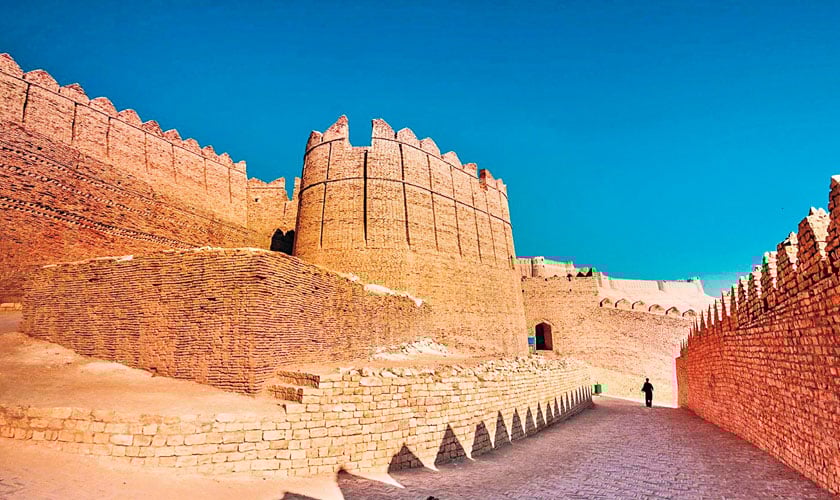
In the vast, sun-scorched plains of what is now eastern Iran, near the modern city of Torbat-e Heydarieh, lie the silent, crumbling ruins of a once-great metropolis. Its name, Hormita, rarely echoes in popular histories of the ancient world, overshadowed by the gleaming reputations of Persepolis, Babylon, or Palmyra. Yet, for centuries, this forgotten city stood as a vital nerve center of empire, a crucible of cultural exchange, and a testament to human resilience. To unearth Hormita’s story is to recover a vital, missing chapter in the narrative of the Silk Road, one that reveals the profound and enduring legacy of places that history books have seemingly passed by.
Hormita’s origins are shrouded in the mists of antiquity, but it rose to prominence during the Parthian Empire (247 BCE – 224 CE). The Parthians, masters of a vast realm stretching from the Euphrates to the Indus, understood the paramount importance of control and communication. Hormita was strategically planted at a critical junction on the great east-west caravan routes—the embryonic Silk Road. It was not merely a stopover, but a major administrative and military headquarters, a dagaba or fortified town designed to project power, protect precious trade flows, and administer a restless frontier province. Its formidable walls and robust citadel spoke of its defensive purpose, guarding the empire’s heartlands from incursions from the Central Asian steppes.
However, Hormita’s true significance transcended its military function. It was here that the remarkable Parthian relay postal system, a marvel of ancient logistics described by historians like Herodotus and later refined, had a pivotal node. Imperial messengers could traverse thousands of miles with astonishing speed, thanks to stations like those at Hormita where fresh horses and riders awaited. This made the city a nexus of information, where intelligence, diplomatic missives, and commercial news converged and disseminated. The very machinery of empire pulsed through its streets.
With the fall of the Parthians, Hormita did not fade into oblivion. It was absorbed into the succeeding Sasanian Empire (224–651 CE), which further fortified it against its perpetual enemy, the Byzantines, and the rising threat of Hephthalite (“White Hun”) invaders. The city’s strategic value endured, its walls thickened by Sasanian engineers. It was likely a scene of fierce conflict as empires clashed for control of the lucrative Silk Road. Life within those walls was a rich tapestry. While no grand palaces or spectacular temples have (yet) been unearthed to rival those of better-known sites, archaeological fragments tell a story of a cosmopolitan hub. Zoroastrian fire temples would have coexisted with Nestorian Christian churches and, later, Buddhist stupas, as merchants, missionaries, and migrants from across Asia passed through its gates. Local pottery mingled with Roman glass and Chinese silk, making Hormita a living museum of global connection long before the term “globalization” existed.
The city’s decline was likely a slow unraveling rather than a catastrophic fall. The Arab-Muslim conquests of the 7th century CE introduced a new political and religious order, shifting trade routes and administrative centers. The focus moved to newly founded cities better suited to the Caliphate’s needs. The death blow may have been delivered by the cataclysmic Mongol invasions of the 13th century, which systematically devastated the region’s irrigation systems—the lifeblood of any Central Asian city. Gradually, the caravan traffic bypassed its weakened walls, the bustling streets fell quiet, and the sands began their patient reclamation.
Yet, declaring Hormita “forgotten” is not to say its legacy vanished. Its endurance lies in subtle, pervasive forms. First, it is a legacy of infrastructure and idea. The very concept of a secure, state-maintained trade and communication network, perfected by the Parthians and Sasanians at nodes like Hormita, set a template. This model would inspire the later yam system of the Mongol Empire and echoes in the organizational logic of all subsequent long-distance networks. Hormita was a physical chip in the circuit board of ancient globalization.
Second, its legacy is one of cultural synthesis. The city was a permeable membrane where ideas filtered through. A religious doctrine debated in its caravanserai might find expression in a manuscript hundreds of miles away. An artistic motif on a piece of Sasanian silver, traded in Hormita’s market, could later resurface in the metalwork of medieval Europe or the paintings of Central Asia. In this way, Hormita acted as a silent catalyst in the cross-pollination that defined Eurasian history, proving that cultural exchange often happened not just in celebrated capitals, but in the bustling, anonymous hubs between them.
Finally, and perhaps most powerfully, Hormita’s legacy is historical and archaeological. It stands as a critical corrective to history’s spotlight. Our understanding of the past is often skewed toward the monumental, the victorious, and the well-documented. Cities like Hormita represent the essential connective tissue—the glue of empire—that made those glittering capitals possible. Its ruins force us to contemplate a more complete map of antiquity, one filled with strategic towns, military garrisons, and merchant towns that sustained the flow of goods, people, and ideas. For modern Iran, Hormita is a source of deep local pride and a piece of national heritage, anchoring the historical identity of the Khorasan region.
Today, the site, known more commonly as Robat-e Sharaf (with its magnificent later Seljuk caravanserai built nearby), is a palimpsest. The visible ruins largely date from the later Islamic periods, but beneath them lie the Parthian and Sasanian foundations, awaiting further exploration. Each potsherd, each coin, each layer of collapsed masonry is a cipher from a world that once was.
Hormita’s story is a profound reminder that history is not merely written by the winners, but is also built, maintained, and lived by the inhabitants of countless forgotten places. Its enduring legacy is not etched in towering monuments, but in the very patterns of human interconnection it facilitated. It whispers from the dust that the arteries are as vital as the heart, and that in the silent spaces between the celebrated peaks of history, the true, enduring work of civilization is often done. In remembering Hormita, we remember the indispensable, forgotten nodes in the network of our shared human past.